Energy System Modelling
Simulate before investing
Bottom-up modeling and techno-economic analysis to design and manage the BESS based on the system’s real-world behavior.
We model the energy system from its components, usage profiles and operating logic. The model simulates generation, consumption, electrification, storage and grid interaction over time, comparing different configurations and strategies before investment decisions are made.
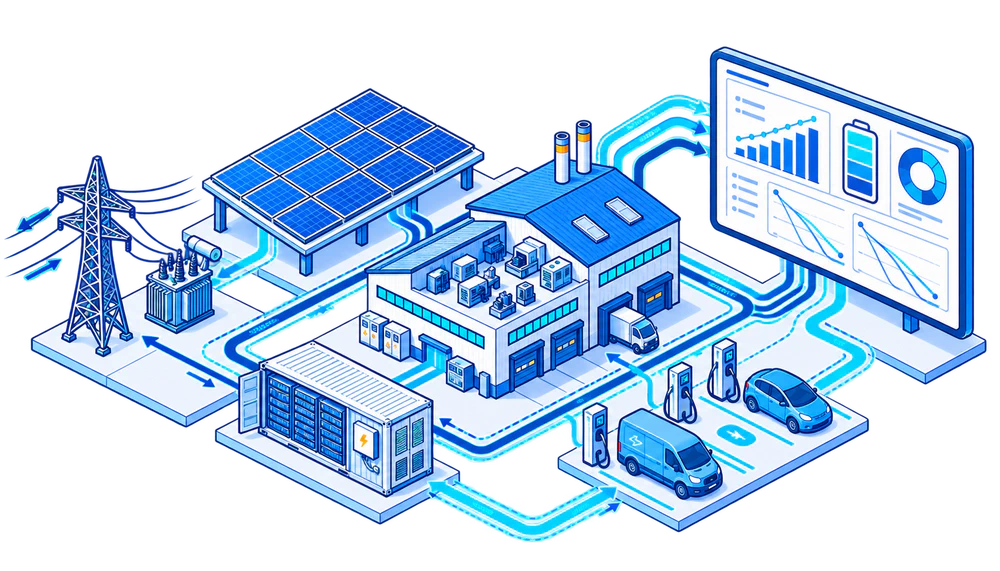
Bottom-up modeling
From individual asset behavior to the energy system
Simulation does not start from a few aggregate parameters. Each relevant component is modeled through its operating behavior and contributes, step by step, to building the overall energy profile.
Generation
Renewable generation profiles, resource availability and hourly variability are modeled over time. The model assesses how the energy produced supplies loads, feeds the grid and charges the BESS.
Loads
Consumption is modeled as distinct time profiles linked to the behavior of the different energy users, so that peaks, operating cycles and the actual scope for flexibility are clearly distinguished.
Electrification
New electrical loads are simulated from actual use rather than aggregate estimates. Mobility, processes and climate control enter the model with specific constraints and operating patterns.
BESS
The BESS is represented by power, energy, SoC, efficiency and operating constraints. The control strategy determines when to charge, discharge or preserve capacity for subsequent scenarios.
Interactive environment
Simulation in action
The model generates an interactive environment in which to explore the system, adjust assumptions and compare alternative scenarios.
Process
The Energy System Modelling process
Sizing, operating strategy and economic assumptions are progressively refined to identify robust configurations, rather than simply the best result in a single scenario.
Scope and objectives
Define the system to simulate, the decisions to support and the assessment criteria.
Data collection and validation
Collect energy, technical and economic data and check that they are consistent.
Baseline energy analysis
Establish the current energy profile and the main operating constraints in place.
BESS operating scenarios
Define the storage operating logic and the operating conditions to be compared.
Iteration and refinement
Review assumptions and options iteratively to progressively refine the solution.
Recommendation and decision
Compare configurations and select the most robust investment options.
Financial model and sensitivity
Translate energy results into economic indicators and analyze critical variables.
Sizing and simulation
Simulate size, constraints and strategies to estimate technical performance.
Scope and objectives
Define the system to simulate, the decisions to support and the assessment criteria.
Data collection and validation
Collect energy, technical and economic data and check that they are consistent.
Baseline energy analysis
Establish the current energy profile and the main operating constraints in place.
BESS operating scenarios
Define the storage operating logic and the operating conditions to be compared.
Sizing and simulation
Simulate size, constraints and strategies to estimate technical performance.
Financial model and sensitivity
Translate energy results into economic indicators and analyze critical variables.
Recommendation and decision
Compare configurations and select the most robust investment options.
Iteration and refinement
Review assumptions and options iteratively to progressively refine the solution.
Scenarios
A range of possibilities, beyond a single scenario
The model explores alternative configurations, assumptions and trajectories, assessing how robust decisions are under different operating and economic conditions.
Battery degradation
BESS behavior can be assessed by considering how the operating strategy affects degradation and the evolution of performance over time.
Sensitivity analysis
CAPEX, energy prices, load growth, efficiency, degradation and other key variables can be adjusted to measure their impact on the results.
Probabilistic scenarios
When future variables are uncertain, distributions of scenarios can be analyzed rather than relying on a single deterministic forecast.
What-if
analysis
Configurations, sizing and operating logic can be adjusted and compared quickly to assess the technical and operational options under evaluation.
Shape the future of energy with us
Get in touch to discover our solutions, book a demo, or start a conversation about your next project. At muleML, we believe in democratizing data and machine learning, making complex technologies simple and accessible. Our approach is gradual and pragmatic: we start with quick wins within everyone’s reach, while building a path toward long-term transformation.
Contact us